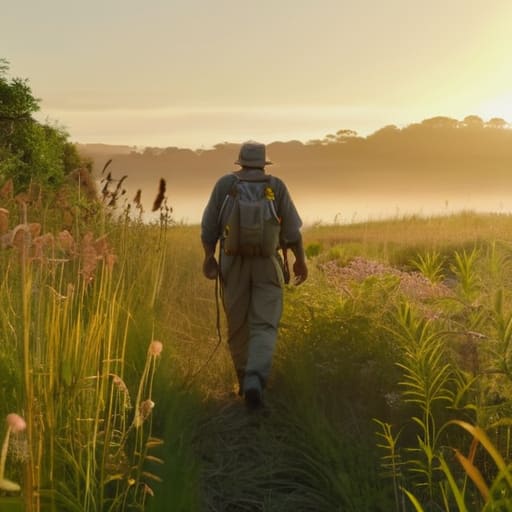
I remember standing in a damp hedgerow at 5:00 AM, my boots squelching in mud that felt more like porridge, trying to distinguish a Bombus terrestris from a particularly large hoverfly while my thermos sat empty. Most people think learning how to run a survey as a volunteer requires a PhD or a high-tech digital counter, but that’s a lie that keeps people away from the field. You don’t need expensive gear or a lifetime of taxonomic mastery to be useful; what you actually need is a bit of patience and the ability to stop overthinking the data.
In this guide, I’m stripping away the academic jargon and the “expert-only” gatekeeping that makes ecology feel inaccessible. I’ll show you how to actually collect data that scientists can use, rather than just making a list of pretty things you saw in the garden. We are going to focus on the unsexy, essential mechanics of consistent counting—the kind of stuff that actually moves the needle for conservation.
Table of Contents
Standardized Research Procedures Over Casual Observations

There is a massive difference between “I saw a cool moth in my garden” and “I recorded a Macroglossum stellatarum at 21:00 on a transect.” One is a lovely moment; the other is a data point. When we talk about standardized research procedures, we aren’t trying to suck the joy out of nature—we’re trying to make sure our efforts actually count for something in a peer-reviewed paper. If everyone uses their own personal definition of “a few” or “a lot,” we end up with a mountain of noise that tells us absolutely nothing about whether a population is actually recovering or just shifting its timing.
This is where the rigor comes in. To make your observations useful to researchers, you have to follow the specific protocol provided, even if it feels a bit rigid. Whether it’s the exact timing of a sweep net sample or the specific way you record weather conditions, these details are what turn a casual stroll into meaningful citizen science. We need to move past the “vibes-based” ecology of social media and embrace the discipline of consistent measurement. Without that structure, we aren’t building a map of biodiversity; we’re just sharing anecdotes.
Ensuring Survey Response Accuracy in the Field

Once you’ve mastered the protocol, the next hurdle is the human element. When you’re out in a field or a local park, you aren’t just interacting with the landscape; you’re interacting with people. If you are using community outreach survey methods to gauge local attitudes toward pesticide use or habitat loss, you have to realize that people are often defensive. If they feel judged for their gardening habits, they’ll give you the answer they think you want to hear, not the truth. This is where ensuring survey response accuracy becomes a social skill rather than just a scientific one.
You need to build a rapport that allows for honesty without making anyone feel like they’re being interrogated by the local council. Part of this involves maintaining survey respondent anonymity—if a farmer thinks their specific land use is being logged for a public database, they’ll stop talking to you entirely. We aren’t just collecting numbers; we are collecting human perspectives that are often colored by fear or misunderstanding. If we don’t handle that interaction with care, we end up with a dataset that is essentially useless for real conservation planning.
Stop Guessing and Start Recording: Five Rules for the Field
- Learn the difference between a genus and a species before you head out. If you record a “bumblebee” when you actually saw Bombus terrestris, you haven’t given us data; you’ve just given us a vague suggestion. Precision is the difference between a useful map and a pile of guesses.
- Respect the weather, even when it’s miserable. If the protocol says “sunny, low wind,” don’t try to be a hero and survey during a drizzle just because you’ve already walked two miles. Wet wings don’t fly, and if you record zero sightings on a rainy day, we can’t tell if the insects are gone or if they’re just hiding from the downpour.
- Document the “non-bugs” too. The temperature, the cloud cover, and the state of the vegetation are just as important as the insect count. A high count in a drought year means something very different than a high count in a wet spring, and without those environmental notes, the numbers are hollow.
- Avoid the “hero” trap of over-reporting. It is tempting to write down every single movement you see to feel like you’ve had a productive day, but if you can’t be certain it was the target species, leave it out. I would much rather have a dataset with gaps than a dataset full of false positives that ruins a trend line.
- Keep your gear—and your notes—dry. A smudge of mud on a data sheet or a damp notebook can turn a week of hard work into illegible scribbles. If we can’t read your location or your timestamp, that data is effectively dead the moment you hand it in.
The Bottom Line for Fieldwork
Data is only as good as its consistency; if you change your method halfway through the season because the weather turned, you aren’t collecting data, you’re just collecting anecdotes.
Focus on the protocol, not the “cool” finds; a hundred sightings of a common Bombus terrestris recorded exactly according to the transect rules is worth infinitely more to a conservationist than one blurry photo of a rare orchid bee.
Learn to embrace the “null” result; not seeing anything during a survey isn’t a failure of your effort, it is a vital piece of evidence that tells us exactly where the habitat is failing.
From Data Points to Real Change
At the end of the day, being a good volunteer isn’t about how many species you can name or how many hours you spend squinting at a hedgerow; it is about the integrity of your data. We have spent this time talking about why protocols matter and why a “maybe” in your notebook is often more useful than a confident but wrong guess. If you stick to the standardized methods, respect the survey’s specific goals, and prioritize accuracy over sheer numbers, you stop being a casual observer and start being a legitimate contributor to the scientific record. It is the difference between making noise and building a foundation that researchers can actually use to defend these habitats in court or in policy papers.
I know it can feel a bit clinical, and maybe a little tedious, to follow a strict checklist when you just want to see what’s flying. But please remember that every precise count you submit is a tiny, vital brick in a much larger wall of evidence. We are currently fighting a battle against a very quiet, very massive decline, and we cannot win it with guesswork or “vibes.” By doing the rigorous, unglamorous work of proper surveying, you are giving a voice to the species that can’t speak for themselves. You aren’t just counting bugs; you are documenting survival.
