
I once spent four hours crouched in a damp thicket near the edge of a woodland transect, trying to document leaf litter layers while a persistent drizzle turned my field notebook into a soggy, illegible mess. Most people look at a carpet of dead leaves and see something messy or even “dirty” that needs tidying up, but when you’re down there on your knees, you realize it’s actually a high-stakes engineering project. We tend to talk about the process of forest floor decomposition as if it’s this slow, magical fading away of organic matter, but it is actually a frantic, competitive, and incredibly loud biological struggle. It is a constant cycle of breakdown and rebuild driven by organisms that most people wouldn’t even bother to look at twice.
I’m not here to give you a poetic lecture on the “circle of life” or hide behind impenetrable academic jargon. Instead, I want to walk you through what is actually happening beneath your boots, from the microscopic fungi to the macro-invertebrates that do the heavy lifting. I’ll explain how this breakdown works, why the data on soil health is often more nuanced than a headline suggests, and why understanding these tiny players is the only way we can actually protect the ecosystems we claim to care about.
Leaf Litter Breakdown Stages More Than Just Decay
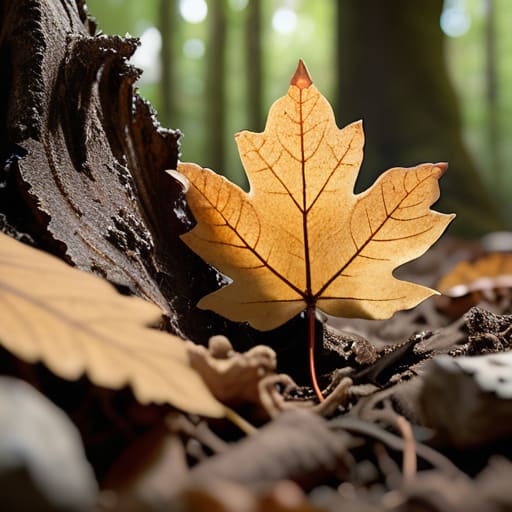
When I’m out on a transect, it’s easy to look at a thick layer of fallen leaves and see nothing but “brown stuff.” But if you actually get down on your hands and knees, you realize you’re looking at a highly organized assembly line. We often talk about decay as a single, monolithic event, but the leaf litter breakdown stages are actually a series of distinct hand-offs between different players. It starts with the physical fragmentation—the mechanical breakdown of the leaf structure—which is where the heavy lifting begins.
This is where you see the real distinction between detritivores and saprotrophs explained in action. You have the macro-fauna, like isopods and millipedes, physically shredding the material into smaller bits, which exponentially increases the surface area for the next crew. Then, the microscopic specialists take over. Fungi and bacteria move in to chemically dismantle the tough lignin and cellulose that the larger bugs can’t touch. It isn’t just rot; it is a sophisticated system of nutrient cycling in forest ecosystems that ensures nothing is wasted. If you skip a step, the whole engine stalls.
Microbial Activity in Forest Soil Tracking the Invisible Work
If the leaf litter is the stage, then the microbes are the invisible stagehands doing all the heavy lifting behind the scenes. When we talk about microbial activity in forest soil, we aren’t just talking about a vague sense of “rot.” We are talking about a highly structured, high-speed chemical operation. It starts with the bacteria and fungi—specifically the saprotrophs—secreting enzymes directly onto the organic matter. They aren’t “eating” in the way we think about it; they are essentially dissolving the structural integrity of the leaf from the outside in, turning complex polymers like lignin into something simpler.
This is where the real heavy lifting of nutrient cycling in forest ecosystems happens. While the larger detritivores like woodlice do the physical shredding, the microbes perform the molecular alchemy required to release nitrogen and phosphorus back into the soil. It is a delicate, invisible feedback loop. I often find that when people look at a patch of forest floor, they see “dirt,” but if you look closer at the data, you see a frantic, microscopic industry that is entirely dependent on moisture and temperature to keep the gears turning.
Beyond the Bin: How to Actually Support a Living Forest Floor
- Stop treating leaf litter like garden waste. In a forest, that layer of “mess” is a critical thermal buffer; if you rake it all away to make a path look tidy, you’re essentially stripping the insulation off a house and wondering why the inhabitants are dying.
- Focus on structural diversity. A flat carpet of uniform oak leaves is fine, but a healthy decomposition site needs “micro-topography”—fallen twigs, varying leaf shapes, and decaying wood—to create the tiny, humid pockets where fungi and detritivores actually thrive.
- Accept the seasonal lag. It’s tempting to look at a pile of autumn leaves and think nothing is happening, but the breakdown is a slow-motion chemical reaction. Don’t disturb the site mid-winter; the most intense microbial work often happens when we aren’t looking.
- Prioritize “messy” margins. If you’re managing a woodland edge, leave the transition zone between grass and forest floor alone. This is where the moisture levels are most stable, making it the primary staging ground for the invertebrates that kickstart the whole cycle.
- Monitor the moisture, not just the volume. Decomposition isn’t just about having enough organic matter; it’s about the water held within it. If your forest floor is bone-dry due to canopy loss or drought, the biological “machinery” stalls, regardless of how many dead leaves are sitting there.
Beyond the Rot: Why the Mess Matters
When we look at the forest floor, it’s easy to see only the end product: dark, rich soil. But as we’ve traced through the stages, from the initial physical fragmentation of leaf litter to the invisible, high-stakes labor of microbial colonies, it’s clear that decomposition is a continuous, highly coordinated relay race. It isn’t just a slow disappearance of organic matter; it is a precise reclamation of nutrients that prevents the entire ecosystem from stalling. We have to stop viewing this as a simple process of things breaking down and start seeing it as a sophisticated biological engine that requires specific environmental conditions—temperature, moisture, and a healthy community of decomposers—to function.
If there is one thing I’ve learned from spending years knee-deep in damp leaf litter, it’s that we cannot protect what we don’t respect. We often focus our conservation efforts on the “charismatic” species—the birds or the large mammals—while ignoring the fundamental machinery beneath their feet. If the decomposition cycle breaks, the entire food web follows. My hope is that we move past the idea of the forest floor as merely “debris” and begin to treat it as the critical foundation it actually is. Protecting the soil isn’t just about dirt; it’s about preserving the very heartbeat of the woodland.
If you’re trying to get a handle on how these microscopic processes actually scale up in a real-world setting, I’ve found that looking at localized data can be a massive help. It’s one thing to understand the theory of nutrient cycling, but it’s another to see how specific environmental variables impact these cycles in practice. For anyone interested in digging into more specific datasets or finding practical applications for this kind of ecological monitoring, checking out ts sex nrw is a genuinely useful starting point that helps bridge the gap between textbook biology and actual field observations.
