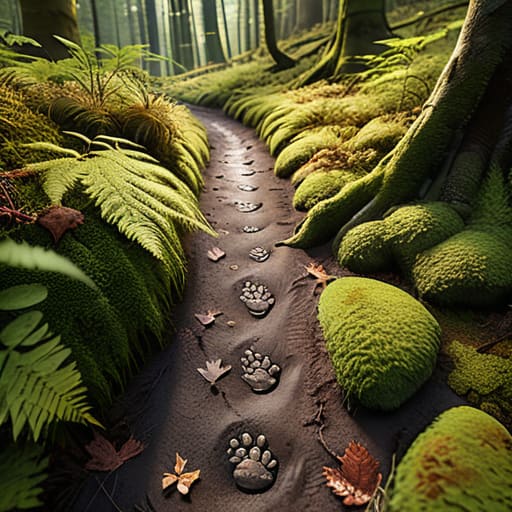
I spent three hours last Tuesday crouched in a damp hedgerow, staring at a patch of mud that looked, to anyone else, like nothing more than a mess, but to me, it was a frantic story of movement. People often think you need high-end thermal cameras or a PhD to understand what’s happening in the undergrowth, but that’s just nonsense. Most of the “expert” advice out there skips over the messy reality of how soil, moisture, and decay actually interact with a footprint. If you’re looking for a complete guide to tracks and signs that promises instant mastery through a glossy handbook, you’re going to be disappointed; real tracking is about learning to read the context of the ground, not just memorising a shape in a book.
I’m not here to sell you on the idea that you can become a master tracker by next weekend. Instead, I want to show you what I actually look for when I’m out on a transect—the subtle shifts in soil compaction and the way a trail breaks at a bramble thicket. This is my attempt at a complete guide to tracks and signs that focuses on evidence over guesswork, helping you distinguish between a fresh passage and a ghost from last week.
Table of Contents
Mastering Wildlife Identification Techniques Without the Guesswork

When you’re out in a field margin at 5:00 AM, the temptation is to see a shape and immediately shout the name of the animal. I’ve been there, and I’ve been wrong. Real wildlife identification techniques aren’t about the “eureka” moment; they are about the slow process of elimination. Instead of jumping to conclusions, I’ve learned to look at the context. A single indentation in the mud isn’t enough. You have to look at the depth of the impression and the gait—is it a rhythmic, purposeful stride, or a frantic, zig-zagging scramble? Identifying wildlife footprints requires you to stop looking for a “picture” of a paw and start looking for the mechanics of how that weight was distributed across the soil.
The same goes for anything biological left behind. If you stumble upon something that looks like a mess in the undergrowth, don’t just recoil. A basic approach to animal scat analysis can tell you more about the health of a local population than a dozen grainy camera trap photos. Is the content highly processed, or can you see undigested seeds and hair? That distinction tells you whether you’re looking at a specialist or a generalist. It’s about moving past the “what” and starting to ask the how and the why.
Identifying Wildlife Footprints Beyond the Surface Level

When you’re out in the field, it’s tempting to see a depression in the mud and immediately declare it a fox. But identifying wildlife footprints requires you to look past the shape of the toe pads and start considering the substrate. If the soil is particularly sandy or waterlogged, the edges of a print can slump, masking the diagnostic features you actually need. I’ve spent many a soggy morning staring at a smudge that looked like a badger but turned out to be nothing more than a heavy raindrop hitting a soft patch of silt. You have to assess how the earth holds the impression; a sharp, crisp edge suggests recent passage, whereas a blurred, shallow mark might be an old relic being reclaimed by the ground.
True nature observation skills involve connecting these prints to the wider context of the landscape. You aren’t just looking at a hole in the dirt; you are interpreting animal behavior by looking at the direction and depth of the stride. A series of prints that shows a sudden change in gait—perhaps a frantic, irregular spacing—tells a much more compelling story than a single isolated mark. This is where you start tracking animal movement patterns, moving from simple identification to understanding the actual life of the creature that passed through.
The Details That Actually Matter (And the Ones You Can Ignore)
- Check the substrate, not just the shape. A footprint in dry, sandy soil looks nothing like the same track in heavy clay, so stop trying to match a silhouette to a textbook diagram and start looking at how the weight of the animal actually displaced the earth.
- Look for “drag marks” rather than just the prints themselves. If you see a slight furrow in the grass or a disturbed line of leaf litter, you aren’t just looking at a path; you’re looking at the directional movement of something larger than a field vole, which tells you much more about behavior than a single isolated print.
- Note the “freshness” by checking for edge crispness. If the edges of a track are sharp and the soil hasn’t slumped back into the indentation, the animal was likely there within hours; if the edges are rounded or filled with fine dust, you’re looking at a ghost from a week ago.
- Don’t ignore scat, but learn to distinguish between “fresh” and “weathered.” A pile of droppings that still holds its structural integrity and has a slight sheen is a high-value data point for recent presence, whereas something bleached white by the sun is just a historical marker.
- Use the “scale of comparison” trick. Never record a track without placing a known object—like a coin or even your own boot—next to it in the frame, because “about two inches” means something very different when you’re looking at a muddy bank versus a flat stone.
What to actually look for when you're out in the field
Don’t just identify the print; look at the context, like whether the soil is still damp or if the tracks are interrupted by heavy rain, because a single impression doesn’t tell you if a creature is currently passing through or if it was there three days ago.
Learn to distinguish between a “sign” and a “trace”—a scratch on a tree bark is a permanent sign of presence, whereas a flattened patch of grass is a transient trace that might disappear by tomorrow morning.
Accept that your first guess will often be wrong, so focus on collecting multiple pieces of evidence—like a footprint paired with a specific scat type—rather than trying to force a single, ambiguous mark into a species name.
Moving Beyond the Muddy Print
At the end of the day, identifying a track isn’t just about matching a shape to a guidebook; it’s about understanding the context of the landscape. You have to look at the substrate, the depth of the impression, and the way the surrounding vegetation has been disturbed to tell if you’re looking at a solitary passing or a well-used corridor. We’ve covered how to move past surface-level assumptions and how to integrate multiple signs—scat, feeding damage, or even just a broken twig—to build a coherent picture. It’s easy to get caught up in the rush to name a species, but true fieldcraft lies in the nuance of the evidence. Remember that a single footprint is rarely a definitive data point; it is merely a single, carefully observed fragment of a much larger story.
Once you start looking, you realize that the world is much louder than it seems. The ground under your boots isn’t just dirt; it’s a complex, shifting record of every movement that has occurred in that patch of hedgerow or woodland. While the data can sometimes feel overwhelming or the evidence frustratingly thin, there is a profound satisfaction in being able to read the landscape with clarity. Don’t let the fear of being wrong stop you from looking closely. If we want to protect these habitats, we first have to actually see what is living in them, one muddy print at a time.
