I spent three weeks of my second summer as an undergrad standing knee-deep in a marshy field margin, shivering in a waterproof jacket that had long since lost its battle with the rain, all because I couldn’t tell if I was looking at a common meadow grass or a specific sedge that indicated a much healthier wetland ecosystem. There is this pervasive, annoying idea that you need a high-end botanical key and a magnifying loupe just to understand what’s under your feet, but honestly, that’s a barrier to entry we don’t need. If you want to learn how to identify grasses and sedges without feeling like you’re back in a first-year biology lecture, you have to stop looking at the whole clump and start looking at the structural details that actually matter.
I’m not here to give you a textbook list of Latin names to memorize for no reason. Instead, I’m going to show you the practical, tactile ways to differentiate them—like the “three-edged” rule for sedges—so you can actually use this knowledge during your next walk. My goal is to move past the vague “it looks like a weed” stage and get you to a place where you can read the landscape with actual precision. We’ll stick to what the surveys actually measure, focusing on the specific traits that tell us whether a patch of ground is a biological desert or a thriving habitat.
Table of Contents
Mastering the Monocot Plant Identification Guide
If you’re standing in a damp field margin with a clipboard and a slightly damp pair of boots, the first thing you need to accept is that your eyes are going to lie to you. Everything looks like a blurry green smudge from five feet away. To actually get anywhere with a monocot plant identification guide, you have to stop looking at the “greenery” and start looking at the architecture. I spent three weeks of my PhD staring at nothing but stem junctions, and I promise you, the secret isn’t in the color; it’s in the geometry.
The most reliable shortcut for distinguishing graminoids in the field is the classic “edges” test. If you can run your finger along the stem and feel a sharp, distinct ridge, you’re likely looking at a sedge—the triangular stem vs round stem distinction is the gold standard for a reason. If it’s smooth and cylindrical, it’s probably a grass. If it feels somewhat fleshy or “squishy,” you’re moving into the territory of rushes. It sounds overly simplistic, but when you’re trying to map out a population of specific habitat-builders, getting the stem shape right is the difference between a meaningful survey and a guess.
Distinguishing Graminoids in the Field Without Guesswork
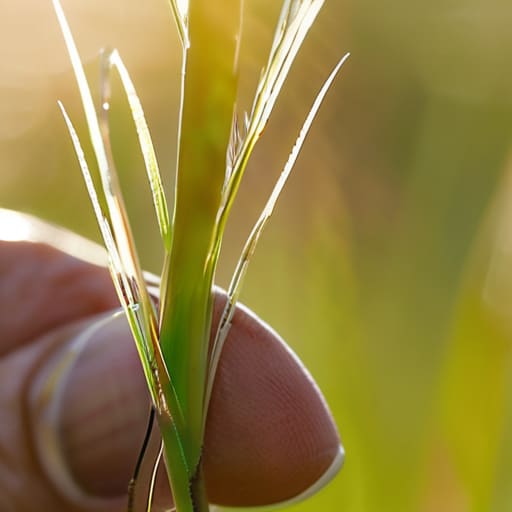
When I’m out on a transect, the biggest mistake I see people make is trying to identify a plant from ten feet away based on its general “greenness.” If you want to actually succeed at distinguishing graminoids in the field, you have to get your hands dirty. The most reliable trick is the “three-sided” rule. Most sedges (Cyperaceae) possess a triangular stem vs round stem architecture that you can feel even through light gloves. If you roll the stem between your fingers and it feels like a soft-edged prism, you’re likely looking at a sedge. Grasses (Poaceae), on the other hand, are almost always cylindrical and tend to have a bit more “give” when you bend them.
However, don’t let a round stem fool you into thinking it’s definitely a grass; that’s where identifying rushes by stem shape becomes the next level of the game. Rushes (Juncaceae) are often quite fleshy and round, but they lack the hollow or pithy center of many grasses. I always tell my moth group to check the leaf sheath characteristics too. If the leaf wraps tightly around the stem like a little sleeve, you’re seeing a classic monocot trait that helps narrow down the family before you even look at the seed head.
Fieldwork Shortcuts: How to Actually Tell Them Apart When You're Knee-Deep in a Hedgerow
- Check the stem first; if it’s round and hollow, you’re likely looking at a grass, but if it feels triangular and solid under your thumb, you’ve almost certainly found a sedge.
- Look closely at the leaf arrangement, because grasses usually have leaves that wrap around the stem in a sheath, whereas sedges tend to have leaves that spiral or just emerge individually from the stem.
- Don’t ignore the seed heads, or spikelets if you want to be precise; grasses often have branched, looser flowering parts, while sedges usually have much tighter, more compact clusters.
- Pay attention to the habitat, because while there is massive overlap, sedges are much more likely to be the stars of the show in damp, boggy patches or heavy clay soils where grasses might struggle to dominate.
- Use the “Sedge is Sharp” rule as a mental fallback, meaning that if the leaf edges feel slightly abrasive or “toothy” against your skin, you are likely dealing with a sedge rather than the smoother blades of most common grasses.
The Fieldworker’s Cheat Sheet
Stop relying on color or general “greenness” to identify a plant; if you want to tell a grass from a sedge, you have to physically feel the stem—if it’s round and hollow, it’s likely a grass, but if it’s triangular and solid, you’ve almost certainly found a sedge.
Pay attention to how the leaves join the stem, because the presence or absence of a sheath is often the only thing standing between a correct identification and a data error that skews your entire biodiversity survey.
Accept that “graminoid” is a massive, messy umbrella term, and the goal isn’t to memorize every single species in the field, but to master the structural differences that allow you to categorize what you’re seeing accurately enough to actually use the data.
Beyond the Identification Guide
At the end of the day, distinguishing between a grass and a sedge isn’t just a technical exercise for my PhD thesis; it’s about understanding the structural architecture of a habitat. We’ve looked at the stem geometry—remembering that if it’s triangular, you’re likely looking at a sedge—and we’ve touched on how leaf arrangement and even the way they hold their seed heads can tell a story. It is easy to walk past a field margin and see a generic green blur, but once you start looking for those specific morphological markers, the landscape starts to fragment into something much more complex and interesting. Getting the identification right matters because data integrity starts with the person on the ground, and if we can’t name what we’re seeing, we can’t effectively track how these plant communities are shifting under pressure.
I know that staring at a clump of damp vegetation in a muddy field margin can feel a bit tedious, especially when you just want to get back to the warmth of your kitchen. But there is a quiet, profound power in being able to look at a patch of ground and actually read the biological census written there. When we stop treating “greenery” as a monolith and start recognizing the distinct roles that different graminoids play in supporting pollinators and soil health, we move from being mere observers to becoming informed advocates. Don’t worry if you don’t get every species right on your first attempt; accuracy is a practice, not a destination, and every single correct identification is a step toward a more nuanced understanding of the world we are trying to save.
