
I spent three hours last Tuesday knee-deep in a drainage ditch, trying to scrape a relatively intact core sample without obliterating the very thing I was trying to study. There is a specific, heavy scent to healthy, undisturbed earth—a mix of damp minerals and something sharp and fermented—that you just don’t get from a textbook. Most people look at a patch of dirt and see a static stage for their plants to sit on, but when you actually get your hands dirty, you realize that understanding how soil ecology functions is less about chemistry sets and more about managing a chaotic, living web. It isn’t just “dirt”; it is a high-stakes biological marketplace where every microscopic transaction matters.
I’m not here to sell you a proprietary blend of expensive microbes or give you another alarmist headline that makes you want to pave over your garden in despair. Instead, I want to talk about what the surveys actually show us. I’m going to break down the messy, unglamorous reality of the subterranean world, from fungal networks to the tiny engineers that keep your garden from turning into a brick. My goal is to move past the hype and show you which small, evidence-based shifts in your soil management actually move the needle for biodiversity.
Table of Contents
Nutrient Cycling in Soil Moving Past the Simplistic Models
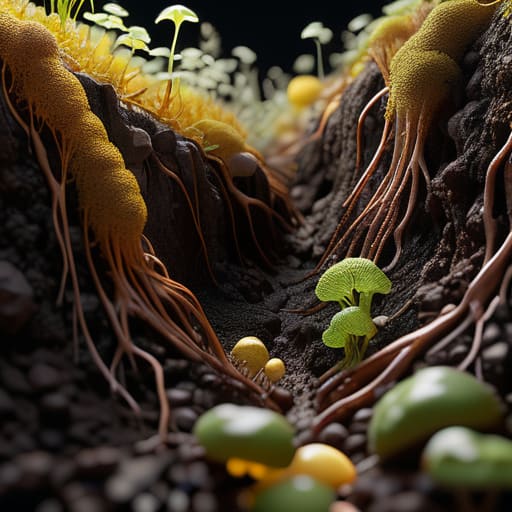
We tend to talk about nutrient cycling in soil as if it’s a simple, linear conveyor belt—dead stuff goes in, nutrients come out, plants grow. It’s a tidy way to teach it in a freshman biology lecture, but it ignores the sheer, messy chaos of what’s actually happening under a hedgerow. In reality, it’s a frantic, non-stop negotiation. You have billions of organisms competing, cooperating, and occasionally dying in a microscopic tug-of-war that dictates whether a plant actually gets the nitrogen it needs or if it just sits there starving in “rich” dirt.
A huge part of this negotiation happens in the rhizosphere, that tiny, high-stakes zone immediately surrounding plant roots. This isn’t just a passive space; it’s a hotspot of intense activity where plants actually trade sugars for minerals. This is where mycorrhizal fungi symbiosis becomes the real MVP. These fungi don’t just sit there; they extend the reach of the root system, acting like a biological internet that moves resources around. When we overlook these specific, localized interactions in favor of broad “soil health” slogans, we miss the actual mechanics of how a landscape stays productive.
The Chaos of Soil Food Web Dynamics
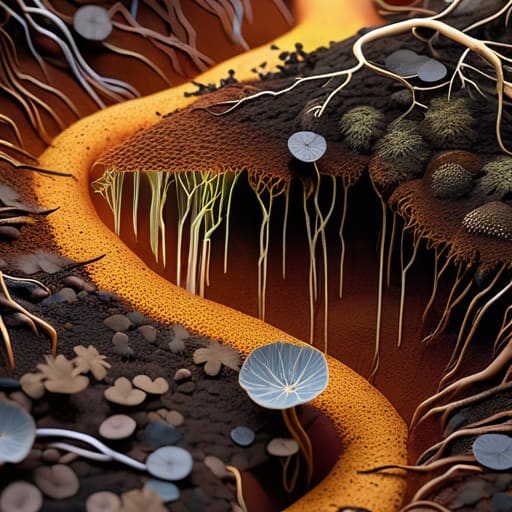
We often talk about the soil food web as if it’s a neat, pyramid-shaped diagram in a textbook, but in a real field margin, it’s much more of a frantic, unscripted scramble. It isn’t just a linear chain of “who eats whom”; it is a constant, high-stakes negotiation. You have protozoa grazing on bacteria, which in turn are processing the latest bit of leaf litter, all while being influenced by the microscopic chemical signals leaking from a plant root. This rhizosphere microbial activity is where the real heavy lifting happens, but it’s incredibly sensitive to even minor shifts in temperature or moisture.
When we look at soil food web dynamics, we have to account for the fact that these interactions are rarely stable. A single heavy rain event doesn’t just “wet the soil”—it can physically shift the community structure or flush out certain populations entirely. It’s a non-linear system, meaning a small change in one corner of the web can have disproportionate effects elsewhere. We shouldn’t mistake the occasional snapshot from a survey for a permanent state; we are essentially trying to photograph a riot in slow motion.
Beyond the N-P-K: How to Actually Support Your Soil’s Living Machinery
- Stop treating your soil like a pantry. When we talk about “feeding the plants” with synthetic N-P-K (nitrogen, phosphorus, potassium), we’re essentially bypassing the soil food web entirely. It’s like giving a person a glucose drip instead of a meal; the person survives, but the digestive system—the microbes and fungi—atrophies from disuse. To build ecology, you have to feed the organisms, not just the roots.
- Embrace the “messy” margin. In my field surveys, I see a massive difference between manicured lawns and the chaotic edges of hedgerows. Soil ecology thrives on structural diversity. Leaving leaf litter, fallen twigs, and even a bit of “untidiness” provides the micro-habitats that keep decomposers like collembola (springtails) and mites active. They are the frontline workers of nutrient cycling, and they need cover to do their jobs.
- Prioritize fungal-to-bacterial ratios. Most gardening advice focuses on bacteria because they’re fast-acting, but a healthy, resilient soil profile relies heavily on mycorrhizal fungi. These fungal networks act as an extended nervous system for plants, transporting phosphorus and water far beyond the reach of the roots. If you’re tilling heavily, you’re effectively shredding that biological infrastructure.
- Manage moisture, don’t just add water. Soil microbes are highly sensitive to “pulse” events—those sudden shifts from bone-dry to waterlogged. Constant saturation can lead to anaerobic conditions where the wrong kind of bacteria take over, often losing nitrogen to the atmosphere as gas. Aim for consistent, sponge-like moisture by increasing organic matter, which acts as a buffer against these extremes.
- Watch the carbon input, not just the minerals. We often obsess over adding minerals, but carbon is the actual currency of the soil. Every bit of organic matter you add—compost, mulch, or even cover crops—is a slow-release energy source for the microbial community. Without a steady stream of carbon, the biological engine eventually stalls, no matter how much fertilizer you pour on top.
What to actually remember when the science gets messy
Soil isn’t just a container for plants; it’s a high-stakes biological marketplace where every microscopic interaction dictates whether a landscape thrives or stalls.
We have to move past the idea of “healthy” versus “unhealthy” soil and start looking at functional diversity—it’s not just about having microbes, but about having the right mix of specialists to handle specific stressors.
If we want to fix broken ecosystems, we have to stop treating soil like a static ingredient and start treating it like a living, breathing system that requires constant, nuanced management rather than a one-off chemical fix.
Beyond the Dirt: Why the Microscopic Matters
We can’t go back to seeing soil as just a pile of minerals and dead leaves. As we’ve looked at, the reality is far more volatile; it is a high-stakes game of chemical exchange and predator-prey tension where nutrient cycling isn’t a predictable conveyor belt, but a series of unpredictable, localized surges. When we disrupt the food web—whether through heavy tilling or chemical inputs—we aren’t just removing a few organisms; we are snapping the individual threads that hold the entire biological machinery together. Understanding this complexity is the only way to move past the “black box” approach to land management and start seeing the soil for what it actually is: a living, breathing entity.
I know that talking about microbial flux and nitrogen mineralization can feel a bit detached from the actual sensation of standing in a field, but there is a profound agency in this knowledge. We don’t need to solve the entire global nitrogen crisis by Tuesday, but we do need to stop treating our ground like a static stage for plants to grow on. If we start making decisions based on supporting the living web rather than just feeding the crop, we move from being mere consumers to being active participants in a much older, much more intricate system. It’s not about perfection; it’s about respecting the chaos that keeps everything alive.
